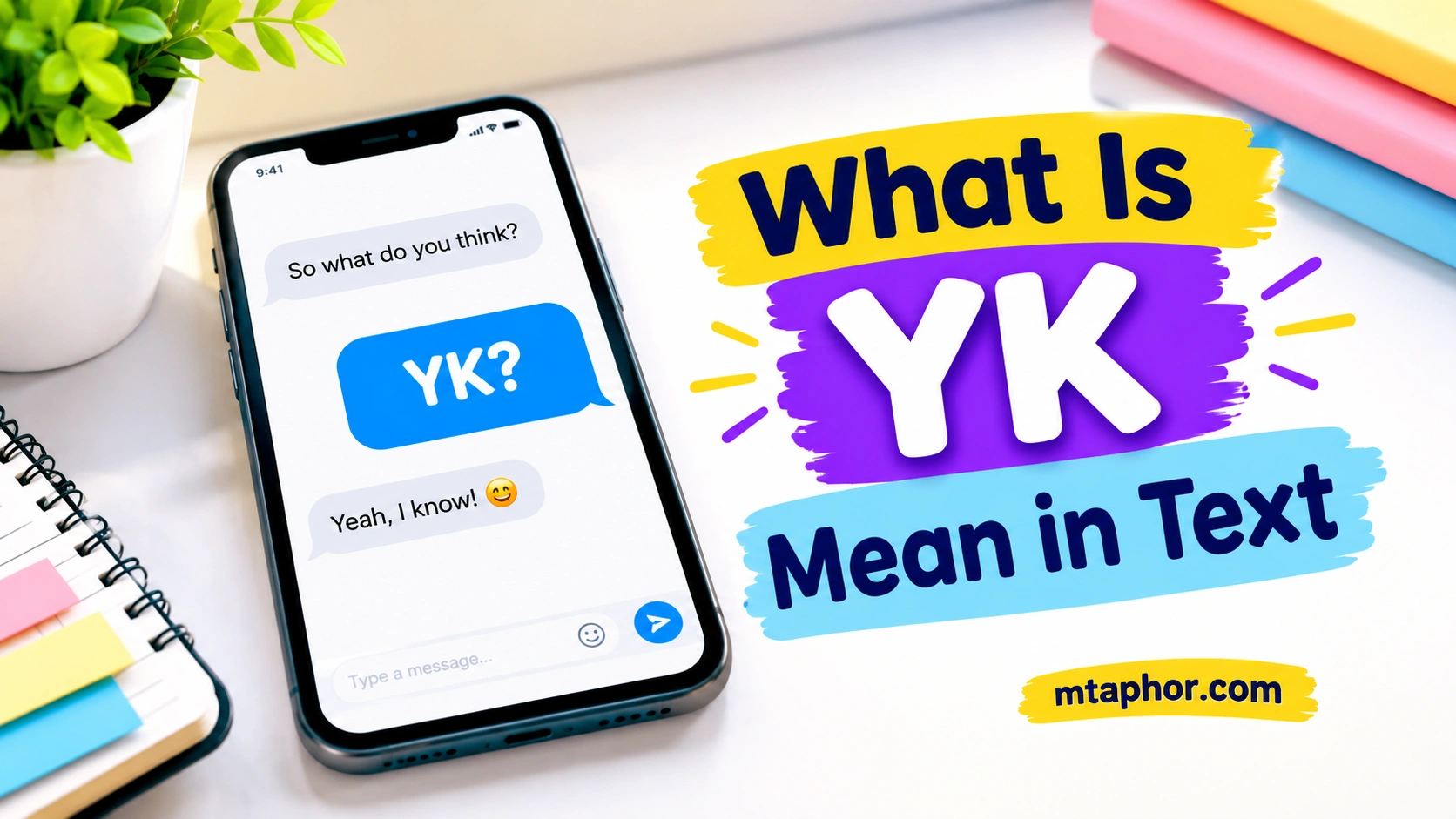
YK usually means “you know” in text messages and online conversations. It is a casual abbreviation people use on TikTok, Snapchat, Instagram, WhatsApp, and regular texting to make messages quicker.
If someone sends you “YK what I mean” or “It was weird, yk?”, they are using yk as a shortened form of “you know.” The exact meaning can depend slightly on the surrounding sentence, but “you know” is the most common interpretation in casual texting.
People often search for “what is yk mean in text” because internet abbreviations can be confusing when they appear without context. Unlike traditional English words, texting slang changes quickly and can mean different things in different conversations.
This guide explains what yk means, how people use it, how to respond, and whether it is appropriate in everyday, school, or professional communication.
YK Meaning in Text
In text messages, YK most commonly means “you know.”
It is an informal abbreviation rather than a traditional acronym. People shorten the phrase because it is already very familiar in spoken English and easy to understand from context.
For example:
“It was awkward, yk?”
This means:
“It was awkward, you know?”
Another example is:
“YK how we always go there?”
Here, yk simply means “you know.”
The abbreviation can appear at the beginning, middle, or end of a sentence. Unlike some slang terms that completely replace a word, yk usually works as a conversational expression.
What Does YK Stand For?
YK = You Know
It can be used when someone assumes the other person understands what they are talking about.
For example:
“YK that guy from school?”
The person is basically asking, “You know that guy from school?”
Is YK Slang or an Abbreviation?
YK is best described as a texting abbreviation or internet shorthand.
It is informal and is mostly found in digital communication. People may use it in text messages, comments, direct messages, captions, and casual online conversations.
It is not normally used in formal essays, business reports, academic assignments, or professional emails.
How YK Works in Everyday Chat
People often use “you know” when speaking naturally:
“I was tired, you know?”
Texting users may shorten it:
“I was tired, yk?”
This makes the message feel quick and conversational.
Sometimes yk does not add much literal meaning. Instead, it gives the sentence a relaxed, spoken tone.
For example:
“That movie was actually good, yk.”
The writer is not necessarily asking a question. They may simply be adding a conversational feeling similar to “you know?”
Where People Use YK
The abbreviation yk can appear across several social media and messaging platforms. Its meaning generally stays the same, although the way people use it can change depending on the conversation.
YK on TikTok
On TikTok, yk can appear in comments, captions, direct messages, and replies.
For example:
“YK what I mean 😂”
A creator or commenter may use it to make a statement sound more casual.
You might also see:
“It’s different when you’re actually there, yk?”
Here, yk means “you know.”
TikTok comments often use short forms because users want to communicate quickly and casually.
YK on Snapchat
Snapchat conversations are usually informal, so abbreviations such as yk can fit naturally.
Someone might write:
“YK I was joking.”
This means:
“You know I was joking.”
Another example:
“That place is fun, yk?”
The abbreviation keeps the message short while preserving the casual tone.
YK on Instagram
Instagram users may use yk in comments, DMs, Stories, and captions.
For example:
“Some people just get it, yk?”
Here, the writer is using “yk” almost like a conversational pause.
In a DM, someone might say:
“YK you can always talk to me.”
The meaning is simply “you know.”
YK on WhatsApp
WhatsApp is another common place to encounter texting abbreviations.
A friend might send:
“YK I don’t like crowded places.”
This is the shortened version of:
“You know I don’t like crowded places.”
Because WhatsApp conversations are often personal and informal, abbreviations like yk can appear naturally.
YK in SMS and Regular Texting
Traditional SMS texting can also contain yk, especially when people are trying to type quickly.
For example:
“I’m tired today yk.”
The sender is not necessarily asking you a question. They are using “yk” as part of a relaxed conversational style.
Real Chat Examples
Seeing yk in realistic conversations can make its meaning easier to understand. Here are ten examples.
Example 1
A: Are you still coming tonight?
B: Yeah, probably.
A: YK we leave at 8, right?
B: Yeah, I’ll be ready.
Here, yk means “you know.”
Example 2
A: Why didn’t you tell me?
B: I didn’t think it was important.
A: YK you can tell me anything.
B: I know. Sorry.
The speaker means, “You know you can tell me anything.”
Example 3
A: Did you like the movie?
B: Yeah, it was better than I expected.
Example 4
A: Are you going to the party?
B: Maybe.
A: You should come, yk.
B: I’ll think about it.
The speaker is encouraging the person casually.
Example 5
A: Why are you laughing?
B: Because of that video.
A: YK which one I’m talking about?
B: Yeah 😂
Here, yk means “you know.”
Example 6
A: How was your first day?
B: A little stressful.
A: Yeah, starting somewhere new is hard, yk.
B: Exactly.
The abbreviation adds a relaxed conversational tone.
Example 7
A: Do you remember that restaurant?
B: Which one?
A: YK, the one near the mall.
B: Oh yeah! I remember now.
Here, yk helps the speaker refer to something they expect the other person to remember.
Example 8
A: I’m probably staying home tonight.
B: Why?
A: Just tired, yk.
B: Fair enough.
The abbreviation functions like “you know” at the end of a sentence.
Example 9
A: I think I need a break.
B: From school?
A: Yeah. YK how exhausting everything has been lately.
B: Yeah, I understand.
Example 10
A: This song hits differently at night.
B: For real.
A: YK what I mean?
B: Absolutely 😂
In this example, yk appears as part of a question meaning “you know what I mean?”
How to Reply When Someone Says YK
There is no special response required when someone uses yk. Your reply should depend on the conversation.
If the person says:
“That was so awkward, yk?”
You could simply say:
“Yeah, I know what you mean.”
Here are some different styles of responses.
Funny Replies
If you’re joking with a friend, you could respond playfully:
- “YK too much 😂”
- “I know exactly what you mean.”
- “Oh, I know 😭”
- “You know I know.”
- “Unfortunately, yes 😂”
These work best when the conversation is already casual.
Casual Replies
For a normal conversation, simple responses work well:
- “Yeah, I know.”
- “I get you.”
- “Exactly.”
- “I know what you mean.”
- “Yeah, totally.”
Friendly Replies
If someone is sharing an experience, you can respond warmly:
- “Yeah, I understand.”
- “I get what you’re saying.”
- “For sure.”
- “Yeah, that makes sense.”
- “I know exactly what you mean.”
Neutral Replies
If you want to keep the conversation straightforward:
- “Yes, I understand.”
- “I see what you mean.”
- “Understood.”
- “That makes sense.”
- “Okay, I get it.”
The best reply depends on the topic, relationship, and tone of the conversation.
Is YK Rude or Offensive?
YK is generally not rude or offensive. It is a casual abbreviation for “you know.”
Using it with friends, family members, classmates, or other people you regularly text is usually harmless.
However, context matters.
Is YK Safe to Use?
In ordinary casual conversation, yes. It does not normally contain an offensive meaning.
For example:
“It was a great day, yk?”
There is nothing rude about this sentence.
Is YK Appropriate at School?
It depends on the situation.
In a casual message to a friend, yk is fine. But in a formal school assignment, essay, presentation, or academic paper, it is better to write “you know” or restructure the sentence entirely.
Formal writing generally avoids internet shorthand.
Is YK Appropriate at Work?
For professional communication, writing “you know” is usually clearer than using yk.
For example, instead of:
“YK what I mean.”
A professional message could say:
“I think you understand what I mean.”
That does not mean using yk at work is always inappropriate. Workplace culture varies, and casual internal chats may allow abbreviations. Still, when communicating with clients, managers, customers, or unfamiliar professional contacts, standard wording is safer.
Who Uses YK?
The abbreviation yk is primarily associated with informal digital communication.
Teenagers and Young Adults
Younger people who regularly communicate through messaging and social media may encounter yk frequently.
It fits naturally with other texting abbreviations because it is short, easy to type, and widely understandable.
Gen Z Usage
Gen Z users often use abbreviations, shortened words, emojis, and conversational expressions online.
However, it would be inaccurate to assume every Gen Z user uses yk regularly. Individual texting habits vary significantly.
Some people prefer abbreviations, while others type out complete sentences.
Common Platforms
You may encounter yk on:
- TikTok
- Snapchat
- Text messages
- Discord
- Online chats
- Other social platforms
The abbreviation is not limited to one particular website.
How Often Does YK Appear Online?
There is no single universal frequency measurement that applies to every platform or age group. Its visibility depends on the community, conversation, and individual writing style.
You are more likely to encounter it in casual conversations than in formal online writing.
Origin of the Term
The phrase “you know” is much older than internet slang. People have used it in everyday speech for a very long time.
The shortened form yk developed naturally from digital communication, where people often shorten familiar phrases to save typing time.
Unlike some slang expressions that have a clearly documented creator or first appearance, there is no widely established single person who can be credited with inventing yk.
Internet Culture and Texting
Early online chats, SMS messaging, forums, and instant messaging encouraged users to communicate quickly.
Over time, many phrases became shortened:
- “you” → “u”
- “are” → “r”
- “be right back” → “brb”
- “I don’t know” → “idk”
- “you know” → “yk”
Not every abbreviation became equally popular, but the general pattern of shortening familiar phrases became an important part of internet communication.
Is the Origin Certain?
The broad explanation is clear: yk is a shortened form of “you know” used in informal digital communication.
However, the exact date and person responsible for first using the abbreviation are not clearly established.
That is common with internet slang because many expressions develop organically across different online communities.
YK vs. IDK, IDC, IMO, and BRB
These abbreviations can look similar because they are all common forms of online shorthand, but they have completely different meanings.
| Term | Meaning | Type | Usage | Popularity |
|---|---|---|---|---|
| YK | You know | Text abbreviation | Casual conversation | Common |
| IDK | I don’t know | Text abbreviation | Answers and uncertainty | Very common |
| IDC | I don’t care | Text abbreviation | Showing indifference | Common |
| IMO | In my opinion | Text abbreviation | Sharing an opinion | Common |
| BRB | Be right back | Text abbreviation | Temporarily leaving a chat | Common |
The key difference is meaning.
YK relates to shared understanding or conversational tone.
IDK communicates uncertainty or lack of knowledge.
IDC communicates that the speaker does not care about something.
IMO introduces a personal opinion.
BRB tells another person that the sender is temporarily leaving the conversation.
Because these abbreviations serve different purposes, you cannot normally substitute one for another.
Real-World Usage Example
Imagine two friends are talking about a teacher, restaurant, movie, or event they both know.
One friend might text:
“That restaurant is always packed, yk?”
The other friend may reply:
“Yeah, especially on weekends.”
The first person is not necessarily asking for an explanation of the restaurant. They are using yk to create a sense of shared understanding.
Another situation might be discussing a personal experience:
“It was just a weird day, yk?”
The phrase “you know” adds a conversational quality. The sender may be inviting the other person to understand the feeling without explaining every detail.
This is one reason yk appears naturally in casual messages. It mirrors the way people sometimes speak in real conversations.
Why Do People Use YK Instead of “You Know”?
The main reason is convenience.
Typing yk takes less time and space than writing “you know.” In fast-moving conversations, small shortcuts can make messages easier to type.
There is also a style element.
Compare:
“That was really strange, you know?”
with:
“That was really strange, yk?”
The second version can feel more like casual online conversation.
Texting language often tries to reproduce the relaxed rhythm of spoken conversation. Abbreviations, emojis, lowercase letters, and shortened words can all contribute to that style.
Can YK Have Another Meaning?
In most casual texting contexts, yk means “you know.”
However, abbreviations can have different meanings in specialized communities. A short combination of letters might represent a username, organization, technical term, or another phrase outside ordinary texting.
That is why context matters.
If someone sends:
“YK what I mean?”
the intended meaning is very likely “you know what I mean?”
But if you see YK in a technical document, company name, game, or specialized community, it may refer to something else.
When in doubt, look at the surrounding words rather than interpreting two letters by themselves.
Common Mistakes When Using YK
Although yk is easy to understand, beginners can still misuse it.
Using It in Formal Writing
Avoid putting yk in academic essays or formal reports unless you are specifically discussing texting language.
Write the complete phrase instead.
Assuming It Always Means the Same Thing
Context matters with abbreviations. Although “you know” is the common texting meaning, specialized contexts can differ.
Overusing It
Putting yk into every sentence can make your messages sound repetitive.
For example:
“YK I went there, yk, and yk it was crowded.”
That sounds unnatural.
Use the abbreviation where it fits the conversation.
Confusing YK With Similar Abbreviations
Don’t confuse yk with idk, imo, or idc.
They represent completely different expressions.
Frequently Asked Questions
What does YK mean in text messages?
YK usually means “you know.” It is an informal texting abbreviation used to make messages shorter and more conversational.
What does YK mean on TikTok?
On TikTok, yk generally means “you know.” It can appear in comments, captions, replies, and direct messages.
Is YK slang?
YK is commonly considered internet slang or texting shorthand, although technically it is more accurately described as an abbreviation for “you know.”
Is YK rude or offensive?
No. YK is generally not rude or offensive. It is a casual abbreviation. However, it may be unsuitable for formal academic or professional writing.
How should you reply to YK?
You can respond naturally based on the conversation. Common replies include “Yeah, I know,” “I get you,” “Exactly,” or “I know what you mean.”
Final Thoughts
So, what is yk mean in text? In most casual conversations, YK means “you know.” It is a short, informal way to make texting feel quicker and more conversational.
You may see it on TikTok, Snapchat, Instagram, WhatsApp, SMS, and other messaging platforms. It can appear at the beginning, middle, or end of a sentence.
The abbreviation is generally harmless and does not normally carry a rude or offensive meaning. Still, it is best suited to casual communication. For school assignments, formal documents, and professional messages, writing “you know” or using a clearer sentence is usually more appropriate.
The easiest way to understand yk is to read the whole message around it. In most everyday texting situations, replacing yk with “you know” will make the intended meaning immediately clear.
Discover More Post
What Does Few Mean in Text ? Real Meaning Examples & Social Media Use 2026
What Does AFC Mean in Text? Real Meaning Examples & Social Media Use 2026

Kir0 is a seasoned English language educator, writer, and SEO content expert with over 10 years of experience in crafting engaging, high-quality content. Specializing in literary devices, metaphors, similes, and figurative language, Kir0 helps readers and writers bring words to life. Passionate about teaching and creative writing, he combines expertise with practical insights to make complex concepts simple and relatable. With a strong focus on SEO-optimized, human-friendly content, Kir0 has guided countless blogs, websites, and educational platforms to achieve higher visibility and audience engagement. On mtaphor.com, he shares valuable tips, examples, and creative ideas to inspire writers, students, and language enthusiasts worldwide