“Oof” in text is an informal reaction that shows pain, disappointment, awkwardness, embarrassment, or sympathy. People use it in texting and on TikTok, Snapchat, Instagram, WhatsApp, and other online platforms.
You may see someone type “oof” after hearing bad news, seeing an embarrassing mistake, or reacting to something difficult. It is usually a quick emotional response rather than a statement with a complicated meaning.
People often search for the meaning of oof because its meaning can change slightly depending on the conversation. Sometimes it means “that hurts,” while other times it is closer to “that’s awkward” or “wow, that went badly.”
The good news is that “oof” is generally easy to understand once you look at the situation around it. This guide explains what it means, how people use it, and how you can reply naturally.
Oof Meaning in Text
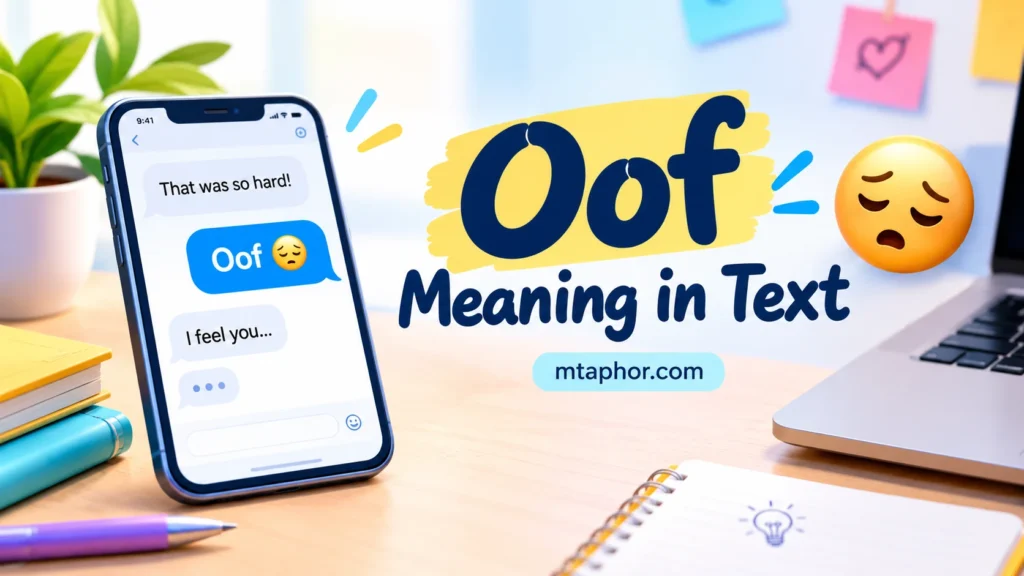
In everyday texting, oof is an informal expression used to react to something unpleasant, painful, awkward, surprising, or disappointing.
For example, imagine your friend tells you:
“I studied all night and still failed the test.”
You might reply:
“Oof, that sucks.”
Here, oof expresses sympathy and disappointment. You are not literally describing an injury. You are reacting emotionally to what happened.
Similarly, if someone sends you a picture of a badly damaged phone, you could say:
“Oof 😬”
In this case, the word communicates something like, “That looks painful,” “That’s unfortunate,” or “That’s going to be expensive.”
Is Oof Slang, an Acronym, or an Abbreviation?
Oof is slang or an informal interjection. It is not normally an acronym or abbreviation where each letter stands for a separate word.
It works more like an emotional sound or reaction.
English speakers sometimes use similar expressions such as:
- Wow
- Yikes
- Ouch
- Ugh
- Oh no
- Jeez
- Oops
However, these expressions do not always mean exactly the same thing.
“Ouch” usually focuses on pain. “Yikes” can express concern or discomfort. “Ugh” often expresses annoyance. “Oof” is broader and can react to many uncomfortable or unfortunate situations.
What Does Oof Mean in Everyday Chat?
The exact meaning depends on context.
Someone might use oof to mean:
- “That hurts.”
- “That’s unfortunate.”
- “That must be difficult.”
- “That was awkward.”
- “That went badly.”
- “Wow, that’s rough.”
- “I feel bad for you.”
- “That was embarrassing.”
It can also be playful.
For example:
Friend: “I accidentally sent my private message to the group chat.”
You: “Oof 😂”
You are probably not expressing serious sympathy.
Why Do People Type “Oof”?
Text conversations do not include facial expressions, gestures, or tone of voice. Short reactions such as “oof” help fill that gap.
Instead of writing:
“I understand that this situation is unfortunate and I feel sympathetic toward you.”
A person can simply type:
“Oof.”
The short response communicates an emotional reaction immediately.
Where People Use Oof
The expression appears across many online platforms. Its meaning stays fairly similar, although the style of communication can change from one platform to another.
Oof on TikTok
On TikTok, people may use oof in comments, captions, replies, or direct messages.
It can appear under a video showing an embarrassing moment, an unfortunate event, a difficult challenge, or a surprising result.
For example:
“Oof, that ending 😭”
The commenter is reacting to what happened in the video.
TikTok users may also combine “oof” with emojis to make the emotional tone clearer:
“Oof 😬”
“OOF 💀”
“Oof, that hurt.”
The capitalization and emoji can change the feeling without changing the basic meaning.
Oof on Snapchat
Snapchat conversations are usually casual and quick, so oof fits naturally into the platform’s messaging style.
A friend might send:
“I dropped my AirPods in water.”
You could answer:
“Oof 😭”
Here, the response shows sympathy.
Snapchat users can also use the word jokingly when reacting to a friend’s story or message.
Oof on Instagram
On Instagram, you might see “oof” in comments, DMs, replies, or reactions to Stories and posts.
For example, someone posts:
“When you realize the deadline was yesterday.”
A friend might comment:
“Oof 💀”
The response suggests that the situation is painfully relatable or unfortunate.
Oof on WhatsApp
WhatsApp users often use oof in one-on-one conversations and group chats.
For example:
Friend: “My car won’t start.”
You: “Oof. Hope you get it fixed soon.”
In this example, “oof” shows an immediate reaction before the person gives a more helpful response.
Oof in SMS Texting
Traditional SMS conversations can use the word too.
It is especially common in informal conversations between friends, family members, classmates, or people who already have a relaxed communication style.
For example:
“Oof, I completely forgot about the appointment.”
The person is reacting to their own mistake.
Real Chat Examples
Seeing the word in realistic conversations is one of the easiest ways to understand it.
Example 1: Bad Test Result
A: I got my exam results back.
B: How did you do?
A: Not good. I failed by two points.
B: Oof. That’s rough.
Here, “oof” expresses sympathy.
Example 2: Expensive Repair
A: My laptop screen cracked today.
B: Oof.
A: The repair shop says it will cost $300.
B: That’s painful.
In this conversation, “oof” reacts to the unfortunate situation.
Example 3: Embarrassing Message
A: I accidentally texted my boss “love you” instead of “thank you.”
B: OOF 😭
A: Please don’t remind me.
B: I’m sorry, but that’s hilarious.
Here, “oof” means something like “That is extremely awkward.”
Example 4: Sports Injury
A: Did you see him fall during the game?
B: Yeah.
A: That looked painful.
B: Oof, definitely.
The word is being used as a reaction to apparent physical pain.
Example 5: Relationship Problem
A: She told me she only sees me as a friend.
B: Oof.
A: Yeah, I’m trying to move on.
B: I understand. Take your time.
Here, “oof” expresses sympathy or emotional pain.
Example 6: Missing a Deadline
A: Wait, the assignment was due this morning?
B: Yeah.
A: Oof. I completely forgot.
B: You should email the teacher.
The speaker uses “oof” to react to their mistake.
Example 7: Awkward Situation
A: He waved back at someone who wasn’t waving at him.
B: Oof 😂
A: He looked so embarrassed.
B: I would have disappeared.
The expression is humorous here.
Example 8: Unexpected Price
A: How much did the tickets cost?
B: $250 each.
A: Oof. That’s more than I expected.
B: Same.
“Oof” communicates surprise and concern about the price.
Example 9: Bad Weather
A: Our outdoor event is tomorrow.
B: Isn’t it supposed to rain all day?
A: Yep.
B: Oof. That’s not ideal.
The expression shows disappointment.
Example 10: A Small Mistake
A: I sent the wrong file to the client.
B: Oof.
A: I noticed immediately and sent the correct one.
B: At least you caught it quickly.
Here, “oof” acknowledges the uncomfortable situation without necessarily being judgmental.
How to Reply When Someone Says “Oof”
There is no single correct response to “oof.” Your reply should match the situation.
If someone uses it sympathetically, you can continue the conversation normally. If they use it as a joke, you can respond playfully.
Funny Replies
If the situation is lighthearted, you could reply:
- “Yep, that was painful 😂”
- “Don’t remind me!”
- “I know, right? 😭”
- “We’re going to pretend that never happened.”
- “I survived somehow.”
For example:
Friend: Oof, that was embarrassing.
You: “My dignity left the chat 😂”
Casual Replies
For normal conversations, simple responses work well:
- “Yeah, seriously.”
- “I know.”
- “Tell me about it.”
- “Exactly.”
- “Yeah, that wasn’t fun.”
- “For real.”
Example:
Friend: Oof, that bill is expensive.
You: “Yeah, I wasn’t expecting that either.”
Friendly Replies
If someone is having a difficult time, show a little more support.
You could say:
- “Yeah, that sounds rough.”
- “I’m sorry. Are you okay?”
- “I hope things get better.”
- “That must have been frustrating.”
- “Let me know if you need anything.”
A simple “oof” can acknowledge someone’s problem, but a supportive follow-up is better when the situation is serious.
Neutral Replies
In situations where you want to stay polite and straightforward, try:
- “Yeah, that’s unfortunate.”
- “I understand.”
- “That sounds difficult.”
- “Hopefully it works out.”
- “That’s not ideal.”
These responses are more appropriate when you do not know the person very well.
Is Oof Rude or Offensive?
Generally, oof is not a rude or offensive expression.
It is usually harmless internet slang or casual language. People use it to express a reaction rather than insult someone.
For example:
“Oof, that’s a tough situation.”
This is normally sympathetic.
However, context matters.
If someone shares something genuinely painful or serious and you respond only with:
“Oof 😂”
they might feel that you are making fun of them.
The word itself is not normally offensive, but the tone and surrounding message can affect how it is received.
Is Oof Safe to Use?
In casual conversations, yes.
It is commonly understood as an informal reaction, especially among people familiar with internet communication.
Still, remember that oof is conversational rather than formal language.
Can You Use Oof at School?
It depends on the situation.
In a private chat with friends, “oof” is perfectly natural. In a formal school assignment, essay, presentation, or academic answer, you would normally choose more precise language.
For example, instead of:
“Oof, the character had a terrible experience.”
A formal analysis might say:
“The character experiences a difficult and emotionally painful situation.”
Can You Use Oof at Work?
It can be fine in casual workplace messaging if the company culture is informal.
For example, a colleague might say:
“The meeting got moved to 7 a.m.”
You could reply:
“Oof, that’s early.”
That sounds casual but harmless.
However, avoid relying on slang in formal emails, official reports, client communication, or professional documents unless you know the communication style allows it.
Who Uses This Term?
“Oof” is used by a wide range of internet users rather than one specific age group.
You may see it among teenagers, young adults, and older internet users who are familiar with online slang.
Gen Z Usage
Gen Z frequently uses short reaction words, emojis, abbreviations, and expressive phrases in digital conversations.
“Oof” fits this communication style because it is quick and emotionally expressive.
That does not mean only Gen Z uses it. The expression has appeared in internet culture for years and can be understood by many different age groups.
Common Platforms
You can encounter “oof” on:
- TikTok
- Snapchat
- Discord
- YouTube comments
- Text messages
- Online gaming communities
Its frequency varies by community and conversation style.
How Often Does Oof Appear Online?
“Oof” is recognizable internet slang, but people do not necessarily use it in every conversation.
Some people use it frequently as a reaction. Others prefer expressions such as “wow,” “yikes,” “ouch,” or emojis.
The popularity of individual slang expressions changes over time, so how often you see “oof” can depend heavily on the online communities you follow.
Origin of the Term
The exact history of oof as an internet expression is not completely straightforward.
“Oof” resembles a natural vocal reaction people make when experiencing or imagining physical discomfort. Similar sounds have been used informally in spoken English for a long time.
Internet culture helped turn the expression into a convenient written reaction.
Gaming communities also played a major role in making “oof” widely recognizable online. In particular, the word became strongly associated with the death sound in Roblox, which helped expose many younger internet users to the expression.
Because of that history, “oof” can have slightly different associations depending on the online community.
Today, however, most people using “oof” in a text message are simply expressing a reaction. They are not necessarily referring to gaming or any particular origin.
Oof vs. Similar Text Expressions
“Oof” can overlap with other common chat expressions, but each one has its own usual role.
| Term | Meaning | Type | Usage | Popularity |
|---|---|---|---|---|
| Oof | Reaction to something painful, awkward, unfortunate, or difficult | Slang / interjection | Casual reactions | Common online |
| IDK | I don’t know | Abbreviation | Uncertainty or lack of information | Very common |
| IDC | I don’t care | Abbreviation | Indifference or lack of concern | Very common |
| IMO | In my opinion | Abbreviation | Giving a personal opinion | Common |
| BRB | Be right back | Abbreviation | Temporarily leaving a chat | Common |
The biggest difference is that oof is primarily an emotional reaction, while the others communicate specific information.
For example:
“IDK what happened.”
means you do not know what happened.
But:
“Oof, what happened?”
expresses a reaction to something that happened.
Likewise:
“BRB”
means you are temporarily leaving.
“Oof” does not provide that kind of direct information. It mainly communicates your emotional response.
Real-World Usage Example
Imagine you are chatting with a friend after school or work.
Your friend tells you that they accidentally left their wallet at home and had to return all the way back to get it.
You might respond:
“Oof, that’s annoying.”
Your friend may then explain:
“Yeah, and then I missed the bus.”
You could reply:
“Oof, today is really not your day.”
The first “oof” acknowledges the inconvenience. The second one adds a little humor and sympathy.
This shows why context matters. Oof does not have one rigid translation. Its emotional meaning changes according to what you are reacting to.
Oof With Emojis
People often combine “oof” with emojis to make the intended tone clearer.
For example:
Oof 💀
Often appears in humorous internet conversations where something is extremely embarrassing, ridiculous, or funny.
Oof 😔
Can make the response sound more sympathetic or serious.
The emoji is not required. A simple “oof” can communicate the reaction on its own.
Does Capitalization Change the Meaning?
Usually, no.
You may see:
- oof
- Oof
- OOF
- ooof
- ooooof
The basic idea remains the same, but spelling and capitalization can add emotional emphasis.
For example:
“Oof.”
sounds like a normal reaction.
“OOOF 😭”
can feel much more dramatic.
People sometimes stretch the spelling to make the reaction seem stronger, just as they might write “noooo” instead of “no.”
Can Oof Be Used Sarcastically?
Yes.
Like many short reaction words, oof can be sincere or sarcastic.
Suppose someone says:
“I only got an A instead of an A+.”
A friend might jokingly respond:
“Oof, tragic.”
The speaker probably does not genuinely feel sorry for them. The exaggerated response is playful sarcasm.
Context, punctuation, emojis, and the relationship between the people involved usually make the intention clear.
When You Should Avoid Using Oof
Although the word is generally harmless, there are situations where a more thoughtful response is better.
If someone tells you about a serious personal problem, illness, loss, or major crisis, replying with only “oof” can sound dismissive.
For example:
Person: “I’m going through a really difficult time with my family.”
A response like:
“Oof.”
may feel too brief.
A better approach would be:
“I’m sorry you’re dealing with that. Do you want to talk about it?”
The lesson is simple: the word is not offensive, but it may not be appropriate for every emotional situation.
Frequently Asked Questions
What does oof mean in text messages?
“Oof” is an informal reaction used to express pain, disappointment, awkwardness, surprise, sympathy, or that something is difficult or unfortunate.
What does oof mean on TikTok?
On TikTok, “oof” is usually a quick reaction to something painful, embarrassing, awkward, surprising, or funny. Its exact meaning depends on the video and comment.
Is oof slang?
Yes. “Oof” is generally considered informal slang or an interjection rather than an acronym or standard formal expression.
Is oof rude or offensive?
Usually not. “Oof” is generally harmless, but using it carelessly in response to a serious situation could sound insensitive.
How should you reply to oof?
Match your response to the context. You can say “Yeah, seriously,” “I know,” or “That’s rough,” or use a funny response when the conversation is playful.
Final Thoughts
Oof is a short, flexible internet expression that communicates an emotional reaction. Depending on the situation, it can mean “that hurts,” “that’s rough,” “that’s awkward,” “that’s unfortunate,” or simply “wow.”
You will commonly see it in casual conversations on TikTok, Snapchat, Instagram, WhatsApp, and through text messages. It can also appear in gaming communities, comments, and other online conversations.
The most important thing is to look at the context. “Oof 😭” after a disappointing event may show sympathy, while “Oof 😂” after an embarrassing mistake may be playful.
The word is generally safe and not offensive, but it is informal. Use it freely in casual conversations when it fits the mood, and choose more thoughtful or formal wording for serious, academic, or professional situations.
Once you understand the context, “oof” is one of those simple internet expressions that is easy to recognize and use naturally.
Discover More Post
What Does RT Mean in Text? Real Meaning Examples & Social Media Use 2026
What Does BWT Mean in a Text ? Real Meaning Examples & Social Media Use 2026

Kir0 is a seasoned English language educator, writer, and SEO content expert with over 10 years of experience in crafting engaging, high-quality content. Specializing in literary devices, metaphors, similes, and figurative language, Kir0 helps readers and writers bring words to life. Passionate about teaching and creative writing, he combines expertise with practical insights to make complex concepts simple and relatable. With a strong focus on SEO-optimized, human-friendly content, Kir0 has guided countless blogs, websites, and educational platforms to achieve higher visibility and audience engagement. On mtaphor.com, he shares valuable tips, examples, and creative ideas to inspire writers, students, and language enthusiasts worldwide