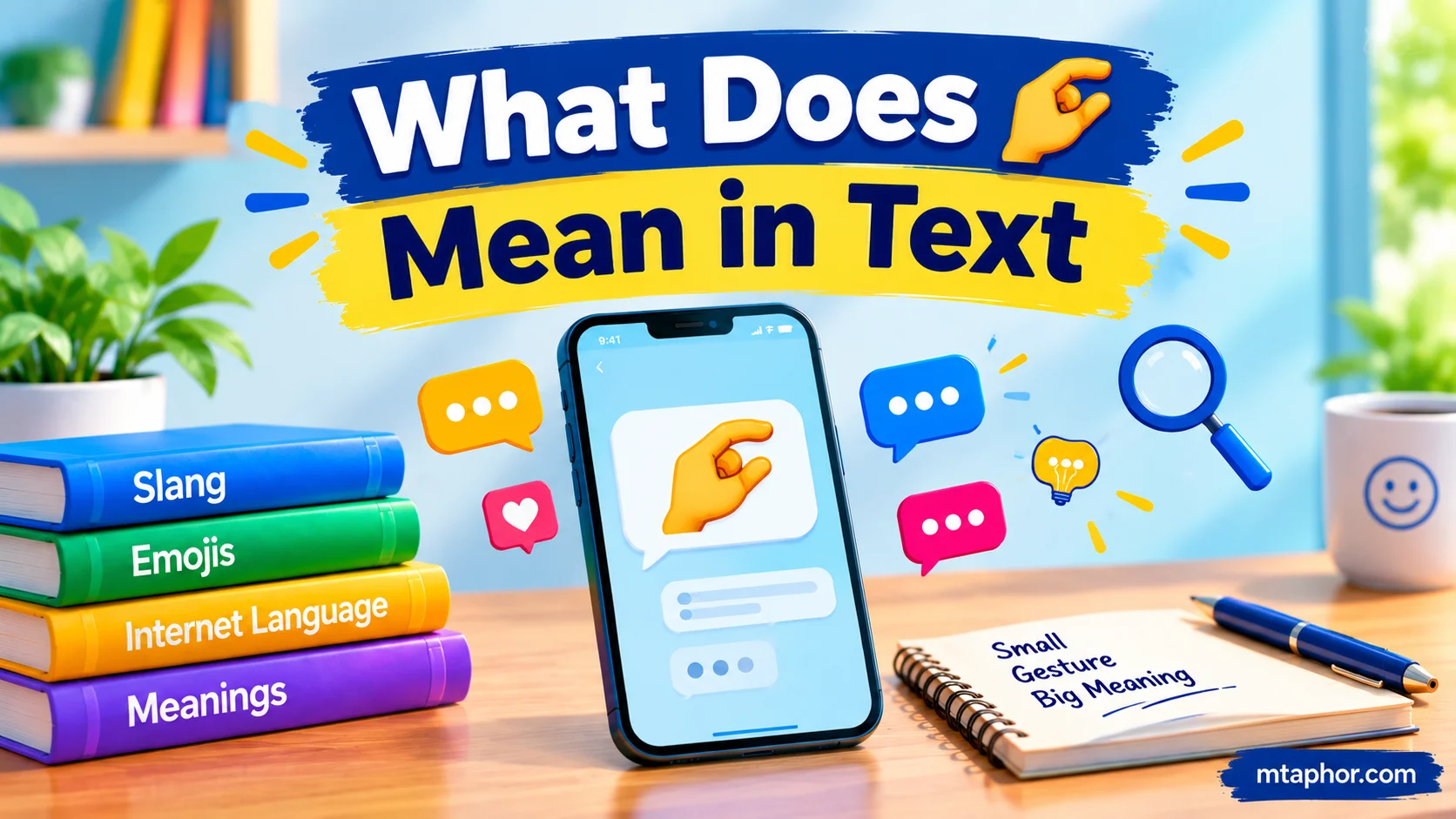
The 🤏 emoji usually means “a little,” “tiny,” or “just a small amount.” In texts and social media, people use it to describe something small, close, precise, or sometimes playfully insignificant.
You may see 🤏 on TikTok, Snapchat, Instagram, WhatsApp, and regular text messages. Its meaning is usually easy to understand from the surrounding conversation, but the tone can change depending on how someone uses it.
For example, someone might text, “I only need 🤏 more time,” meaning they need just a little more time. Another person might use it jokingly to say something is extremely small.
People often search for the meaning of 🤏 because emojis do not always have one fixed interpretation. The same emoji can be cute, funny, sarcastic, descriptive, or even slightly suggestive depending on the conversation.
🤏 Meaning in Text
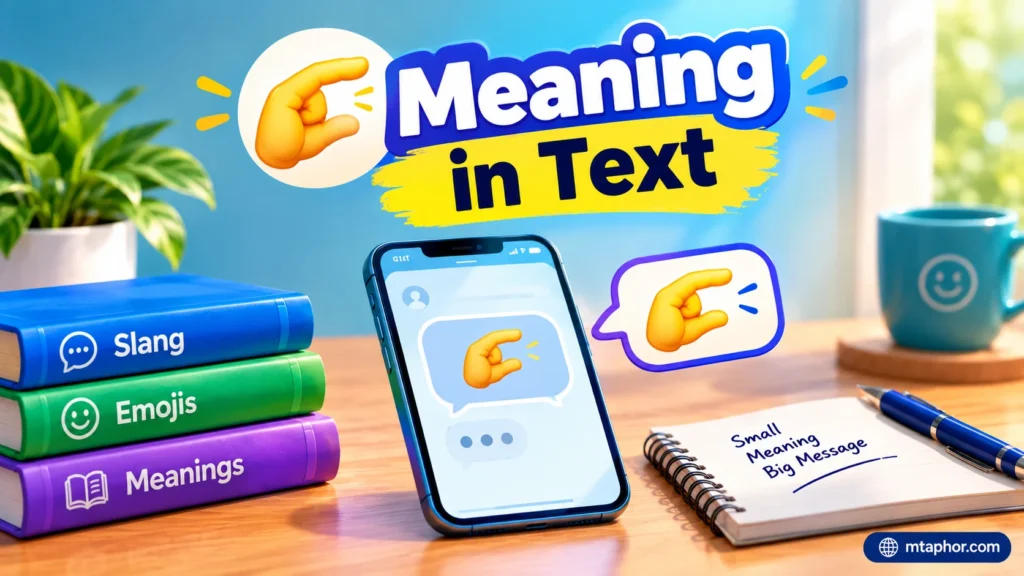
In text messages, 🤏 generally means “a little,” “a tiny amount,” “small,” or “just a bit.”
The emoji is called the Pinching Hand emoji. It shows a hand with the thumb and index finger close together, as if someone is holding or measuring something very small.
Unlike abbreviations such as IDK or BRB, 🤏 is not an acronym or abbreviation. It is an emoji that communicates an idea visually.
In everyday texting, people commonly use it when they want to emphasize that something is small or that they only need a small amount of something.
For example:
“Can you give me 🤏 more time?”
This means:
“Can you give me a little more time?”
Another example is:
“I have 🤏 patience left.”
Here, the person is saying they have very little patience remaining.
The emoji can also make a message sound more playful. Instead of simply writing “a little,” someone might add 🤏 because it gives the sentence a visual and humorous touch.
What does 🤏 literally represent?
The gesture represents pinching something between the thumb and index finger.
Imagine someone saying:
“It’s this small.”
They might hold their fingers close together to show the size. The 🤏 emoji recreates that gesture digitally.
Because of this, the basic idea behind the emoji is smallness or a small amount.
Common meanings of 🤏
Depending on context, 🤏 can mean:
- A little
- A tiny amount
- Just a bit
- Very small
- Almost nothing
- A small difference
- Something precise or measured
- A playful “just this much”
- Something insignificant, jokingly
The surrounding words are important. An emoji by itself may be ambiguous, while the sentence around it usually makes the intended meaning clearer.
Is 🤏 always about size?
No. It can describe more than physical size.
Someone might say:
“I need 🤏 more motivation.”
They are not talking about the physical size of motivation. They mean they need a little more motivation.
Likewise:
“I’m 🤏 close to giving up.”
This can mean the person is very close to giving up.
So, in text conversations, 🤏 can describe a small amount, a small difference, or being close to a particular point.
Where People Use 🤏
The 🤏 emoji is widely understood across social and messaging platforms. The basic meaning usually stays the same, although the tone can change.
🤏 on TikTok
On TikTok, people often use 🤏 in captions, comments, and replies to emphasize something tiny or “just a little.”
For example:
“I have 🤏 money left after shopping.”
A TikTok commenter might also use it humorously when talking about a small amount of something.
It can appear alongside jokes, reaction comments, memes, and short captions.
Sometimes TikTok users use emojis in exaggerated ways. Therefore, 🤏 can mean something is ridiculously small rather than simply small.
🤏 on Snapchat
On Snapchat, 🤏 can be used in direct messages, captions, and replies.
For example:
“Wait, I’m 🤏 late.”
The person may mean they are only slightly late.
Snapchat conversations are usually casual, so the emoji can add a playful or relaxed feeling to a message.
🤏 on Instagram
Instagram users may use 🤏 in comments, captions, Stories, and direct messages.
Someone could comment:
“Just 🤏 obsessed.”
This suggests they are jokingly saying they are “a little” obsessed, even if they actually mean they are very interested.
The emoji can therefore be literal or humorous.
🤏 on WhatsApp
WhatsApp users commonly use 🤏 in personal conversations and group chats.
For example:
“Send me 🤏 money until Friday 😂”
Here, the emoji means a small amount of money and makes the request sound more playful.
Because WhatsApp is often used for conversations with friends and family, the emoji can appear in many different situations.
🤏 in SMS and regular texting
In ordinary SMS or phone messaging, 🤏 has essentially the same meaning.
Someone might write:
“Give me 🤏 time.”
This means:
“Give me a little time.”
In a serious conversation, the emoji may be unnecessary, but among friends it can make the message feel more casual.
Real Chat Examples
The best way to understand 🤏 is to see how people naturally use it.
Example 1: Asking for more time
A: Are you ready to leave?
B: Almost. Give me 🤏 more time.
A: Okay, five minutes.
Here, 🤏 means a little more.
Example 2: Small amount of money
A: How much cash do you have?
B: Honestly, 🤏 😂
A: Same here.
The emoji suggests the person has very little money.
Example 3: Talking about food
A: Want some more cake?
B: Just 🤏.
A: Got it.
Here, 🤏 means a small amount.
Example 4: Being slightly late
A: Where are you?
B: 🤏 late, almost there.
A: No problem.
The person means they are only a little late.
Example 5: Small difference
A: Did you finish the project?
B: Almost. I need 🤏 more work.
A: You’re nearly done then.
Here, 🤏 means a small amount of work.
Example 6: Playful exaggeration
A: How much do you like that song?
B: 🤏 much. 😂
A: Only that much?
The emoji creates a joking tone.
Example 7: Patience
A: Are you still waiting for them?
B: Yeah, but I have 🤏 patience left.
A: I know that feeling.
The person has very little patience remaining.
Example 8: Being close
A: Did you pass the test?
B: 🤏! I missed passing by one point.
A: So close!
Here, 🤏 communicates the idea of being very close.
Example 9: Requesting a small favor
A: Can you help me?
B: Sure, what do you need?
A: Just 🤏 favor.
B: Tell me.
The emoji makes the request feel small or casual.
Example 10: Talking about size
A: How big was the piece?
B: Literally 🤏.
A: That tiny? 😂
Here, the emoji is being used almost literally to describe something very small.
How to Reply When Someone Says 🤏
There is no single correct response to 🤏. Your reply should depend on what the person means.
If someone uses the emoji to mean “a little,” you can respond normally. If they are joking, matching their playful tone can work well.
Funny replies
If the conversation is playful, you could say:
- “That’s all you need? 😂”
- “Define ‘a little.’”
- “That is seriously tiny 😂”
- “You’re asking for the smallest favor ever.”
- “Okay, just a microscopic amount.”
Casual replies
For an ordinary conversation:
- “Sure, no problem.”
- “Okay, give me a minute.”
- “Yeah, that works.”
- “Got you.”
- “A little bit? Sure.”
Friendly replies
If you want to sound warm and helpful:
- “Of course, take your time.”
- “Sure! I can help.”
- “No worries 😊”
- “Absolutely.”
- “Yeah, I’ve got you.”
Neutral replies
In a straightforward conversation, you can simply answer the actual request:
- “Okay.”
- “Sure.”
- “How much?”
- “Give me five minutes.”
- “That’s fine.”
The important thing is to understand the sentence rather than treating 🤏 as a word with one rigid definition.
Is 🤏 Rude or Offensive?
Usually, 🤏 is not rude or offensive.
It is a common hand-gesture emoji and is generally safe in casual conversations. Most people use it to communicate the idea of something being small or minimal.
However, context can change the tone.
Can 🤏 be sarcastic?
Yes.
Someone might use 🤏 to make fun of how little of something another person has.
For example:
“Bro has 🤏 money 😂”
This could be playful teasing.
Whether it is funny or insulting depends on the relationship between the people involved.
Can 🤏 have a suggestive meaning?
In some conversations, the pinching gesture can be interpreted in a sexual or suggestive way, especially when someone is clearly discussing body size or intimate subjects.
That is not necessarily the intended meaning in normal texting. The surrounding conversation determines the interpretation.
If the conversation is innocent and someone writes:
“I only need 🤏 salt.”
there is no obvious suggestive meaning.
Is 🤏 appropriate at school?
Generally, yes. Using the emoji casually is not inherently inappropriate.
Still, students should consider the context. A school assignment, formal email, or message to a teacher usually does not need casual emojis unless the situation allows them.
Is 🤏 appropriate at work?
It can be fine in informal workplace chats, depending on the company culture and who you are messaging.
For example:
“I need 🤏 more time to finish this.”
may be acceptable in a casual team chat.
However, a more professional message would simply say:
“I need a little more time to finish this.”
When communicating with clients, managers, or people you do not know well, plain language is usually clearer.
Who Uses 🤏?
There is no strict age group that owns the 🤏 emoji.
Teenagers, young adults, older adults, and people across different online communities can use it.
Gen Z and 🤏
Gen Z users frequently combine emojis with short, informal messages, memes, jokes, and social-media language.
For them, 🤏 may be used literally or as part of an exaggerated joke.
For example:
“I have 🤏 social battery left.”
This does not mean the person is physically measuring anything. It means their social energy is almost gone.
Younger users
Younger internet users may use 🤏 in humorous comments or reactions.
They may also combine it with other emojis to make the tone clearer.
For example:
“Just 🤏 bit tired 😭”
The combination makes the message feel informal and expressive.
Older users
Older adults may also use the emoji literally to indicate a small amount.
For example:
“Add 🤏 sugar.”
The meaning is still easy to understand because the visual gesture is intuitive.
How often does 🤏 appear online?
The emoji is recognizable and used across major social platforms, but its frequency varies by community and conversation.
It is especially useful when someone wants to visually communicate “small,” “a little,” or “just this much.”
Origin of the Term
🤏 does not really have a “slang origin” in the same way that abbreviations such as BRB or IDK do.
It is an emoji based on a familiar hand gesture: bringing the thumb and index finger close together to indicate something small or a small quantity.
The emoji was standardized as part of modern emoji sets and became available across digital communication platforms as emoji support expanded.
Its meaning is therefore connected more to visual communication and hand gestures than to internet slang.
The exact interpretation can still vary between cultures and contexts. Hand gestures can carry different meanings around the world, so an emoji based on a gesture may sometimes be understood differently by different people.
Internet culture has also expanded its use. Social media users frequently turn simple gestures into jokes, reactions, memes, and exaggerated expressions.
That is why 🤏 can mean more than simply “small.” It can also communicate sarcasm, humor, exaggeration, or “just a little.”
🤏 vs IDK, IDC, IMO, and BRB
These expressions are quite different from 🤏 because most of them are abbreviations used to save typing time.
| Expression | Meaning | Type | Usage | Popularity |
|---|---|---|---|---|
| 🤏 | A little, tiny, small amount | Emoji | Casual texting and social media | Common |
| IDK | I don’t know | Abbreviation | Texting and online chats | Very common |
| IDC | I don’t care | Abbreviation | Casual texting and social media | Common |
| IMO | In my opinion | Abbreviation | Texting, comments, discussions | Common |
| BRB | Be right back | Abbreviation | Chats and messaging | Well-known |
The biggest difference is that 🤏 communicates an idea visually, while IDK, IDC, IMO, and BRB represent phrases using letters.
For example:
“I need 🤏 more time.”
uses an image-like gesture to communicate “a little.”
Meanwhile:
“IDK what happened.”
uses an abbreviation for “I don’t know.”
And:
“IMO, that movie was great.”
uses an abbreviation for “in my opinion.”
These expressions should not be treated as interchangeable. Their meanings and purposes are completely different.
Real-World Usage Example
Imagine two friends are preparing to leave for dinner.
One friend is already waiting outside while the other is getting ready.
The person inside might text:
“I’m almost ready. Give me 🤏 more time.”
The friend outside immediately understands that they do not need a long delay. The emoji reinforces the idea that only a small amount of additional time is needed.
Another real-world example could happen while cooking.
Someone might ask:
“How much salt should I add?”
A person could answer:
“Just 🤏.”
In this situation, the emoji works almost like a visual measurement.
It can also be useful when describing a small difference:
“Move the chair 🤏 to the left.”
Here, the meaning is closer to “just a tiny bit.”
These examples show why the emoji works so well in casual digital communication. It replaces a few words with a visual gesture that most readers can understand immediately.
Frequently Asked Questions
What does 🤏 mean in text messages?
🤏 usually means “a little,” “a tiny amount,” “just a bit,” or “very small.” The exact meaning depends on the sentence and conversation.
What does 🤏 mean on TikTok?
On TikTok, 🤏 commonly represents something small or a little amount. It can also be used jokingly or sarcastically in comments and captions.
Is 🤏 slang?
No, 🤏 is not technically slang, an acronym, or an abbreviation. It is an emoji called the Pinching Hand emoji. People use it as a visual way to communicate ideas such as “small” or “a little.”
Is 🤏 rude or offensive?
Usually, no. 🤏 is generally harmless and commonly used in casual conversations. However, context can give it a sarcastic, teasing, or occasionally suggestive meaning.
How should you reply to 🤏?
Look at the message around the emoji first. If the person means “a little,” you can reply naturally with something like “Sure,” “How much?” or “No problem.” If they are joking, a playful response can work too.
Conclusion
The 🤏 emoji usually means “a little,” “tiny,” “just a bit,” or “a small amount.” It comes from the visual idea of holding something between your thumb and index finger to show that it is small.
In texting, TikTok comments, Snapchat, Instagram, WhatsApp, and other online conversations, people use 🤏 to make messages more visual and expressive. Sometimes it is literal, such as when someone says they want 🤏 food. Other times it is humorous, such as saying they have 🤏 patience left.
The emoji is generally safe and not offensive. Still, context matters. A joke between friends can sound different from a message sent to a teacher, manager, client, or someone you barely know.
If you see 🤏 in a message, start with its simplest meaning: “a little” or “a tiny amount.” Then look at the surrounding words to understand whether the sender is being serious, playful, sarcastic, or simply describing size.
That simple approach will help you understand most uses of 🤏 without overthinking the emoji.
Discover More Post
What Does PK Mean in Text? Real Meaning Examples & Social Media Use 2026
What Does Horu Mean in Text? Real Meaning Examples & Social Media Use 2026

Kir0 is a seasoned English language educator, writer, and SEO content expert with over 10 years of experience in crafting engaging, high-quality content. Specializing in literary devices, metaphors, similes, and figurative language, Kir0 helps readers and writers bring words to life. Passionate about teaching and creative writing, he combines expertise with practical insights to make complex concepts simple and relatable. With a strong focus on SEO-optimized, human-friendly content, Kir0 has guided countless blogs, websites, and educational platforms to achieve higher visibility and audience engagement. On mtaphor.com, he shares valuable tips, examples, and creative ideas to inspire writers, students, and language enthusiasts worldwide