If you see HORU in a text, it usually means “How Old Are You?” It is an internet acronym used to ask someone’s age, especially in casual online chats, social media conversations, and messaging.
You may come across HORU in a message, comment, direct message, or online chat. It is less common than abbreviations such as IDK, LOL, or BRB, but it has been documented as texting slang for asking someone’s age.
People often search “what does horu mean in text” because the four letters are not immediately obvious. Unlike ordinary English words, HORU is formed from the first letters of How Old Are You, so its meaning can be difficult to guess without knowing the slang.
One important point is that HORU is not a standard English word. In texting, it functions as an informal acronym. The surrounding conversation is important because “horu” can also appear as a word or transliteration in languages other than English.
Horu Meaning in Text
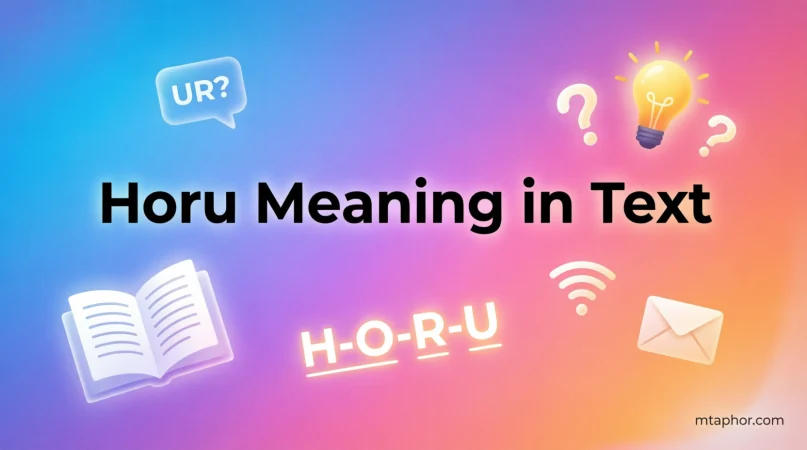
In internet texting, HORU usually means “How Old Are You?”
The person using it is asking about your age. For example, if someone sends:
“Hey, HORU?”
They are essentially asking:
“Hey, how old are you?”
HORU is an acronym, rather than a normal English abbreviation. It takes the initial letters of the phrase:
- H = How
- O = Old
- A = Are
- Y = You
However, the commonly documented form HORU does not literally match every initial in the phrase because the acronym uses “U” for “you.” Texting language frequently replaces words such as “you” with single letters to make messages shorter.
Several slang-reference sources define HORU as “How Old Are You?” and describe it as an online-chat expression used when someone wants to know another person’s age.
Is HORU slang or an abbreviation?
HORU can be described as internet slang, texting slang, or an online acronym.
It is not a formal English abbreviation that you would normally find in professional writing. It belongs to the informal style of communication that developed through chat rooms, SMS, social networks, and other online conversations.
Older lists of texting abbreviations have also recorded HORU with the meaning “How old are you?” alongside other internet expressions.
What does HORU mean in everyday chat?
In everyday online conversation, the meaning is simple:
HORU = How old are you?
Someone may use it when they have just met you online and want to know your age.
For example:
Person A: Hey, where are you from?
Person B: Canada.
Here, HORU is simply a quick way to ask for the person’s age.
It does not automatically express anger, excitement, flirting, or disrespect. The tone depends mostly on the conversation and the relationship between the people involved.
Where People Use HORU
HORU is an informal internet expression, so you are more likely to see it in casual digital conversations than in formal communication.
Its use can vary from platform to platform.
HORU on TikTok
On TikTok, you might encounter HORU in comments, direct messages, or conversations between users.
For example, someone may comment:
“Your videos are funny. HORU?”
The commenter is asking how old the creator is.
However, HORU is not one of TikTok’s most common abbreviations. Many users may not recognize it immediately. TikTok slang changes quickly, and expressions that are popular in one online community may be unfamiliar to another.
If you see HORU on TikTok, look at the sentence around it. If the conversation is about school, age, dating, gaming, or meeting new people, “How Old Are You?” is a likely interpretation.
HORU on Snapchat
Snapchat conversations are often informal, making abbreviations and short expressions common.
Someone who has recently added you might send:
“Hey, HORU?”
They are probably asking your age.
Because Snapchat often involves conversations with people you may not know well, it is worth remembering that you do not have to share your age simply because someone asks.
A simple response could be:
“I’d rather not say.”
That is perfectly acceptable.
HORU on Instagram
On Instagram, HORU may appear in DMs or comments, especially when people are getting to know each other.
For example:
User A: Your profile is cool.
User B: Thanks!
The last message means “How old are you?”
Instagram has a huge variety of communities, so not everyone will use or understand HORU. It is better to interpret the expression based on context rather than assuming every use has the same meaning.
HORU on WhatsApp
WhatsApp is another place where people use abbreviations and casual shorthand.
A person might write:
“HORU btw?”
Here, “btw” means “by the way,” while HORU asks the person’s age.
Because WhatsApp is used by friends, families, classmates, coworkers, and businesses, the appropriateness of using HORU depends on who you are talking to.
With a close friend, it may be completely normal.
In a professional group, it would be unusual and unnecessary.
HORU in SMS
HORU can also appear in text messages, although many modern users simply write “How old are you?” because typing a full sentence is easy on smartphones.
Texting abbreviations became especially popular when people wanted to communicate quickly using limited characters or older phone keyboards. HORU belongs to that broader tradition of shortening phrases for online communication.
Real Chat Examples
The easiest way to understand HORU is to see how it works in natural conversations.
Example 1: Meeting Someone Online
A: Hey, nice to meet you.
B: You too!
A: Where are you from?
B: Texas. HORU?
A: I’m 20.
Here, B asks A’s age using HORU.
Example 2: Gaming Chat
A: You play this game every day?
B: Pretty much 😂
A: Nice. HORU?
B: 18. You?
The abbreviation is being used casually between two gamers.
Example 3: Instagram DM
A: I like your photography posts.
B: Thank you!
A: How long have you been taking photos?
B: About three years.
A: Cool. HORU?
The person is asking how old B is.
Example 4: New Online Friend
A: What school do you go to?
B: I’d rather not say that yet.
A: Fair enough. HORU?
B: I’m 19.
The second question asks for age instead of school information.
Example 5: Casual Conversation
A: Heyyy
B: Hey!
A: What are you doing?
B: Just watching Netflix.
A: Lol same. HORU?
B: 22 😂
This is a casual example of the acronym.
Example 6: Gaming Community
A: You sound really young lol
B: 😂 Maybe I am
A: HORU?
B: Guess.
Here, the person is directly asking the other person’s age.
Example 7: Social Media Chat
A: Your account came up on my feed.
B: Haha nice.
A: Your posts are cool. HORU?
B: 21. Thanks!
Again, HORU means “How old are you?”
Example 8: Friendly Conversation
A: We’ve been talking for an hour and I never asked.
B: Asked what?
A: HORU?
B: I’m 25.
The abbreviation keeps the message short.
Example 9: Someone You Don’t Know
A: Hey, can I ask you something?
B: Sure.
A: HORU?
B: Why do you ask?
This example shows that the person receiving the question may want to know why their age is being requested.
Example 10: Choosing Not to Answer
A: HORU?
B: I don’t usually share my age online.
A: No worries!
This is an important example because you are never required to provide personal information just because someone asks for it.
How to Reply When Someone Says “HORU”
If someone sends you HORU, your response depends on how comfortable you are with the person.
You can answer directly, ask why they want to know, or politely decline.
Funny Replies
If you’re chatting with a friend, you can make the response playful.
- “Old enough to know better 😂”
- “That information is classified.”
- “Take a guess.”
- “Older than I look 😎”
- “Why, are you conducting a survey?”
Funny responses work best when the conversation is already relaxed.
Casual Replies
If you don’t mind answering, keep it simple.
- “I’m 21.”
- “22, you?”
- “I’m 19. How about you?”
- “Twenty-five.”
There is no need to write a long sentence.
Friendly Replies
If you want to keep the conversation warm:
- “I’m 20! How old are you?”
- “I’m 23. What about you?”
- “21 😊 You?”
- “I’m 18. Nice meeting you!”
These replies answer the question while keeping the conversation going.
Neutral Replies
If you want to stay cautious:
- “Why do you ask?”
- “I’d rather keep that private.”
- “I don’t usually share my age online.”
- “I prefer not to say.”
These are useful when the person is a stranger or when you simply do not want to share personal information.
Is HORU Rude or Offensive?
HORU itself is not generally a rude or offensive expression.
It is simply an informal way of asking someone’s age.
However, asking someone how old they are can sometimes feel personal. Whether the question is appropriate depends on the situation, the relationship between the people, and the reason for asking.
For example, asking a longtime friend “HORU?” would normally be harmless.
Sending the same question to a complete stranger may feel intrusive.
Is HORU safe to use?
In ordinary casual conversation, the expression itself is not offensive.
The bigger issue is privacy, not the word itself.
If someone online asks your age, you can decide whether you want to answer. You do not have to reveal personal information to an unknown person.
Is HORU appropriate at school?
It is generally not something you would use in formal school writing.
For a school assignment, write:
“How old are you?”
rather than:
“HORU?”
Texting slang belongs mainly in informal communication.
Is HORU appropriate at work?
Usually, no.
Professional emails, business messages, reports, applications, and workplace documents should use standard language.
Instead of HORU, write the complete question if you genuinely need the information.
For example:
“May I ask how old you are?”
Even then, consider whether asking someone’s age is actually necessary.
Who Uses This Term?
HORU is associated with informal online communication rather than a particular age group.
It can appear in internet chat, social networking, SMS, and other casual messaging environments. Historical lists of texting abbreviations have included HORU among internet slang expressions.
Gen Z usage
Some younger internet users may recognize abbreviations such as HORU, especially if they spend a lot of time in online communities.
That does not mean every Gen Z user knows it.
Internet slang is highly fragmented. Someone can understand dozens of TikTok expressions while having no idea what an older chat acronym means.
Older internet slang
HORU is not necessarily a brand-new expression. Online slang references have documented it for years, including definitions dating back to the early era of social networking and online chat.
That makes it different from some newer slang terms that appear suddenly on TikTok and disappear within a few months.
How often does HORU appear online?
HORU is relatively uncommon compared with highly recognizable abbreviations such as IDK, LOL, BRB, or IMO.
If you have never seen it before, that is not unusual.
Because it is uncommon, context is particularly important.
Origin of the Term
The exact origin of HORU is difficult to establish with certainty.
Unlike a formal abbreviation created by an organization, texting slang often develops gradually across chat rooms, forums, SMS conversations, and social networks.
Several online slang references identify HORU as meaning “How Old Are You?”
Older online abbreviation lists also include the expression among texting and internet slang.
That suggests HORU belongs to the broader culture of internet shorthand, where people shorten common questions to make conversations quicker.
The exact person or community that first coined the expression is not clearly established.
Why did people create abbreviations like HORU?
Internet users have long shortened phrases for convenience.
Examples include:
- IDK — I don’t know
- IDC — I don’t care
- IMO — In my opinion
- BRB — Be right back
- BTW — By the way
- LOL — Laughing out loud
HORU follows the same basic idea: communicate a familiar phrase using fewer characters.
Today, typing a complete sentence is easy, but internet slang remains popular because it can make messages feel casual, quick, and conversational.
Comparison Table
Here is how HORU compares with some better-known texting abbreviations:
| Expression | Meaning | Type | Usage | Popularity |
|---|---|---|---|---|
| HORU | How Old Are You? | Internet acronym | Casual chats and online conversations | Less common |
| IDK | I Don’t Know | Texting abbreviation | Everyday texting and social media | Very common |
| IDC | I Don’t Care | Texting abbreviation | Casual conversations and social media | Very common |
| IMO | In My Opinion | Texting abbreviation | Discussions, comments, messages | Common |
| BRB | Be Right Back | Texting abbreviation | Chats and messaging | Common |
The main difference is that HORU is a question about age, while the other abbreviations communicate an opinion, response, feeling, or temporary absence.
IDK and IDC are especially common because they are useful in everyday conversations.
HORU is more specialized. You would normally use it only when asking someone’s age.
Real-World Usage Example
Imagine you join an online gaming community and start talking with another player.
You have exchanged a few messages, discussed the game, and discovered that you both enjoy the same type of music.
The person then writes:
“HORU?”
They are asking, “How old are you?”
If you’re comfortable answering, you might respond:
“I’m 22. You?”
If you don’t want to share personal information, you can simply say:
“I don’t share my age online.”
The important part is that HORU does not force you to answer. It is just a question written in abbreviated form.
Another situation could happen on social media. Someone may see your profile and send:
“HORU btw?”
The “btw” means “by the way,” while HORU is asking your age.
Again, context makes the meaning clear.
A useful tip when you see HORU
If someone sends you an unfamiliar abbreviation, don’t immediately assume it has one universal meaning.
Look at:
- The words before and after it.
- The platform where you saw it.
- The topic of the conversation.
- The person’s language and background.
- Whether the expression appears to be an acronym or a typo.
This matters because “horu” can have meanings outside English internet slang. For example, dictionaries document “horu” in other languages, including Japanese, where it can be the romanized form of several different Japanese words.
So, if someone uses lowercase “horu” in a Japanese-language conversation, you should not automatically assume they mean “How Old Are You?”
Context always comes first.
Frequently Asked Questions
What does HORU mean in text messages?
In internet slang, HORU usually means “How Old Are You?” It is an informal acronym used to ask someone’s age.
What does HORU mean on TikTok?
On TikTok, HORU can mean “How Old Are You?” when someone uses it to ask another person’s age. However, it is not one of the platform’s most universally recognized abbreviations, so context matters.
Is HORU slang?
Yes. HORU is generally considered internet slang or a texting acronym rather than standard English.
Is HORU rude or offensive?
No. HORU itself is not generally rude or offensive. It simply asks someone’s age. However, asking a stranger for personal information can sometimes feel intrusive.
How should you reply to HORU?
If you’re comfortable answering, simply give your age, such as “I’m 21. You?” If you prefer privacy, say “I’d rather not say” or “Why do you ask?”
Final Thoughts
So, what does HORU mean in text? In the context of internet slang, it usually means “How Old Are You?” It is an informal acronym used in online chats, messages, and social conversations.
You may see it when someone is getting to know you, particularly in a casual online conversation. The expression is not normally rude or offensive, although the question itself can feel personal depending on who is asking.
HORU is also not as common as abbreviations such as IDK, IDC, IMO, and BRB. Because it is relatively uncommon, not everyone will immediately recognize it.
If you receive a message containing HORU, check the surrounding context before deciding what it means. In an English-language texting conversation, “How Old Are You?” is the established slang interpretation. In another language or setting, however, “horu” may have an entirely different meaning.
And remember: you never have to share your age with someone online if you are uncomfortable doing so.
Discover More Post
Metaphors for Being Trapped Powerful Ways to Describe Feeling Stuck 2026
Metaphors for Jesus Powerful Biblical Images That Reveal His Meaning 2026
Powerful Sleep Metaphors Meaning Examples & Creative Uses 2026

Zeni is an experienced English language educator, writer, and SEO content strategist with over 10 years of expertise in teaching, writing, and digital content creation. She specializes in literary devices, metaphors, similes, and figurative language, helping readers understand complex concepts in simple, relatable ways. Passionate about education and creative writing, Zeni combines her teaching experience with SEO knowledge to create high-quality, engaging, and search-optimized content. Her work empowers writers, students, and bloggers to express ideas clearly and effectively. Zeni is dedicated to making learning fun, practical, and accessible for audiences worldwide.