STG usually means “swear to God” in text slang. People use it to emphasize that they are telling the truth, making a serious promise, or strongly expressing how they feel. You may see STG in TikTok comments, Snapchat messages, Instagram DMs, WhatsApp chats, and ordinary text messages.
If someone sends you “STG I didn’t do it,” they are basically saying, “I swear to God, I didn’t do it.” The abbreviation makes the message quicker and more casual.
People often search for this slang because they see it in a message or social media post and are unsure what the three letters mean. Since internet slang changes quickly, even familiar-looking abbreviations can be confusing.
STG Meaning in Text
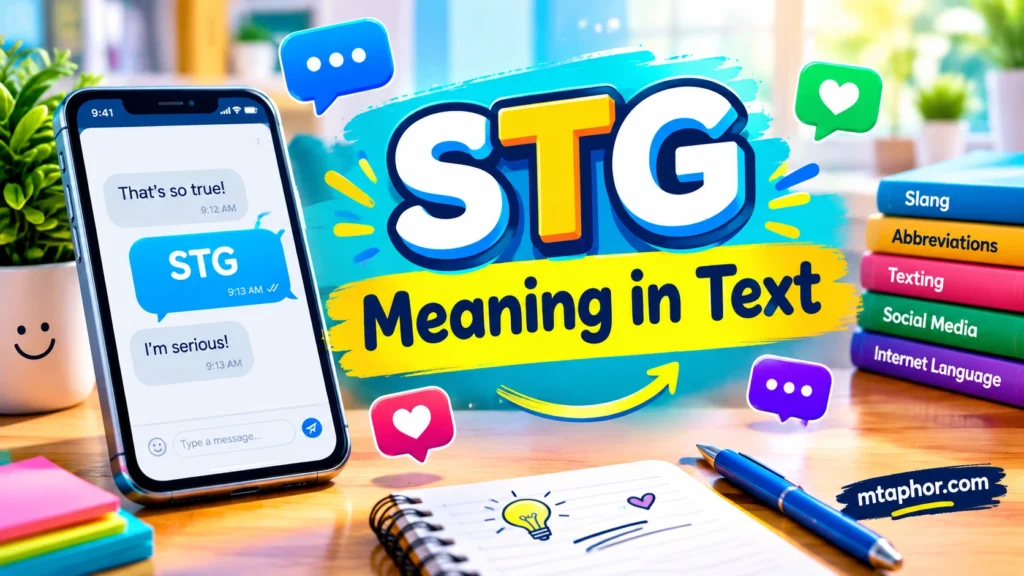
In most texting and social media conversations, STG means “swear to God.” It is an abbreviation commonly used when someone wants to make a statement sound more serious, honest, emotional, or emphatic.
For example:
“STG, I thought you were coming at 8.”
This means:
“I swear to God, I thought you were coming at 8.”
The person is not necessarily making a formal religious statement. In everyday online communication, STG is often simply an expression used to add emphasis.
Is STG Slang, an Acronym, or an Abbreviation?
STG is best described as an initialism or texting abbreviation that has become part of informal internet slang.
The letters come from the first letters of:
- S — Swear
- T — To
- G — God
Unlike a word that people pronounce as one term, STG is generally understood letter by letter when discussed as an abbreviation.
You might see it written as STG, stg, or occasionally in a sentence with other texting shortcuts.
The capitalization usually does not change the meaning. Someone writing “STG” and someone writing “stg” are normally saying the same thing.
What Does STG Mean in Everyday Chat?
The meaning depends slightly on the situation, but the basic idea is “I swear” or “I promise I’m telling the truth.”
Someone might use it when:
- They want you to believe them.
- They are surprised by something.
- They are frustrated.
- They want to emphasize a statement.
- They are making a strong promise.
- They are reacting emotionally.
For example:
“STG this is the funniest video ever.”
Here, the person is not literally making a serious oath. They are simply emphasizing how funny they think the video is.
Another example is:
“stg if he calls me again…”
This can suggest frustration or irritation. The rest of the sentence usually makes the intended emotion clear.
Where People Use STG
STG is most common in informal digital conversations. You can encounter it on several popular platforms, although the exact frequency depends on the people and communities involved.
STG on TikTok
On TikTok, STG may appear in comments, captions, replies, and direct messages.
People often use it when reacting strongly to a video.
For example:
“STG this happens to me every Monday.”
Or:
“stg I watched this five times 😂”
In these situations, STG adds emotional emphasis. It can make the comment sound more personal and expressive.
TikTok users also combine STG with emojis, exaggerated spelling, and other slang. The surrounding comment is usually enough to tell you whether the person is being serious, amused, annoyed, or dramatic.
STG on Snapchat
Snapchat is heavily based on quick, informal communication, so abbreviations are common.
A friend might send:
“stg where are you?”
They may simply mean:
“I swear, where are you?”
The expression can sound impatient, playful, or serious depending on the conversation.
Because Snapchat messages are usually casual, STG does not normally require formal grammar or capitalization.
STG on Instagram
On Instagram, you may see STG in comments, DMs, Stories, captions, and replies.
For example:
“STG you look amazing in this pic.”
Here, the abbreviation is being used to emphasize a compliment.
Someone might also write:
“stg this song never gets old.”
Again, the meaning is essentially “I swear” or “I really mean it.”
STG on WhatsApp
WhatsApp conversations between friends and family can include STG when people want to communicate quickly.
For example:
“STG I left my phone on the table.”
The person is emphasizing that they genuinely believe what they are saying.
WhatsApp also allows people to combine abbreviations with voice notes, emojis, stickers, and other informal communication styles.
STG in SMS Text Messages
Traditional SMS texting is another place where STG can appear.
Someone may type:
“STG I’ll be there in 10.”
The abbreviation saves a little time and gives the sentence extra emphasis.
However, not everyone uses texting slang. Some people prefer to write “I swear” instead of STG, especially when communicating with someone who may not understand internet abbreviations.
Real Chat Examples
The easiest way to understand STG is to see how people actually use it.
Example 1: Defending Yourself
A: Did you eat the last slice of pizza?
B: STG I didn’t.
A: Then who did?
B: Probably my brother.
Here, STG emphasizes that B is insisting they are innocent.
Example 2: Talking About a Funny Video
A: Did you see that video I sent?
B: Yes 😂
A: STG I’ve watched it like ten times.
B: Same. It gets funnier every time.
In this conversation, STG is casual and playful.
Example 3: Being Surprised
A: Guess who I saw at the mall?
B: Who?
A: Our old teacher.
B: STG?! No way.
Here, STG helps express surprise. The exact feeling comes from the entire conversation.
Example 4: Making a Promise
A: Are you actually going to come tomorrow?
B: STG I’ll be there.
A: Okay, I’m trusting you this time.
In this case, the abbreviation emphasizes a promise.
Example 5: Complaining
A: How was your morning?
B: Terrible. STG my alarm didn’t go off.
A: Again?
B: Yes 😭
The speaker is emphasizing their frustration.
Example 6: Talking About Food
A: Have you tried that new burger place?
B: STG the fries are incredible.
A: Seriously?
B: Yes. You need to try them.
Here, STG adds enthusiasm rather than seriousness.
Example 7: Denying Something
A: You deleted my message, didn’t you?
B: STG I didn’t touch it.
A: Hmm, okay.
B: I promise!
The abbreviation reinforces the denial.
Example 8: Expressing Frustration
A: Is your internet working?
B: No. STG this Wi-Fi hates me.
A: Mine is slow too.
Here, the phrase is exaggerated for humor.
Example 9: Showing Excitement
A: The concert tickets are finally available!
B: STG?! Send me the link!
A: Sending it now.
The abbreviation helps communicate excitement and surprise.
Example 10: Casual Agreement
A: This week has felt so long.
B: STG. It feels like Friday should have been yesterday.
A: Exactly!
In this example, STG is being used almost like “I swear” or “seriously.”
How to Reply When Someone Says STG
There is no special response you have to use when someone writes STG. Your reply should depend on what they are saying and the relationship you have with them.
Funny Replies
If your friend is being dramatic, you can answer playfully.
- “Okay, I believe you 😂”
- “You swear too much.”
- “I’ll need evidence first 😂”
- “STG accepted.”
- “That sounds suspicious.”
- “Your honor, I have questions.”
These work best when you already have a joking relationship with the person.
Casual Replies
For a normal conversation, keep the response simple.
- “Okay, fair.”
- “I believe you.”
- “Got you.”
- “Alright.”
- “Okay, I understand.”
- “No worries.”
You do not need to use another abbreviation just because the other person did.
Friendly Replies
If someone is talking about something personal or emotional, a warmer answer may be better.
- “I believe you.”
- “It’s okay, I trust you.”
- “No need to worry.”
- “I know you’re being honest.”
- “Haha, okay, I got you.”
Neutral Replies
If you are not particularly close to the person, you can simply respond to the actual message.
For example, if someone says:
“STG I sent the file yesterday.”
You could reply:
“Okay, I’ll check my inbox again.”
This avoids focusing on the slang and keeps the conversation practical.
Is STG Rude or Offensive?
STG is not generally considered an offensive abbreviation, but it contains the word “God,” so its tone can depend on the person and context.
For many people, “swear to God” is simply an everyday expression. Others may consider religious references inappropriate in casual conversation.
That does not mean STG is automatically rude. Context matters.
Is STG Safe to Use With Friends?
Usually, yes. STG is commonly used in casual conversations between friends, especially in texts and social media.
For example:
“STG that was hilarious.”
This would normally sound informal rather than offensive.
Is STG Appropriate at School?
It depends on the situation.
In a casual message to a friend, it may be fine. However, using texting slang in a school essay, formal assignment, presentation, or communication with a teacher is generally not a good choice.
Instead of:
“STG I finished the assignment.”
A more appropriate sentence would be:
“I promise I finished the assignment.”
Is STG Appropriate at Work?
For professional communication, it is better to avoid STG unless you know the workplace culture extremely well and the conversation is genuinely informal.
A message such as:
“STG I sent the report.”
could sound too casual or emotional in a professional setting.
A better version would be:
“I can confirm that I sent the report.”
The key difference is that STG belongs primarily to informal digital communication.
Who Uses This Term?
STG is mostly associated with people who regularly use texting and internet slang.
Teenagers and Young Adults
Teenagers and young adults are particularly likely to encounter abbreviations such as STG because they communicate frequently through messaging apps and social platforms.
That does not mean older people never use it. Anyone familiar with online slang may understand or use STG.
Gen Z Usage
STG can fit naturally into Gen Z-style online conversations because it is short, expressive, and easy to type.
It may appear alongside expressions such as:
- LOL
- IDK
- IDC
- TBH
- FR
- IMO
- BTW
However, slang changes constantly. A term that is very common in one online community may be less common in another.
Common Platforms
You can encounter STG on:
- TikTok
- Snapchat
- Text messages
- Online chats
- Gaming conversations
- Social media comments
Its meaning generally stays the same across these platforms.
How Often Does STG Appear Online?
STG is recognizable internet slang, but it is not necessarily used by everyone.
Some people use it regularly, while others almost never use abbreviations. Frequency also depends on age, social group, platform, and personal writing style.
That is why seeing STG for the first time does not mean you are expected to start using it yourself.
Origin of the Term
The exact history of STG as an internet abbreviation is difficult to pin to one specific person, website, or date.
The phrase “swear to God” existed long before texting and social media. People have used it in spoken and written language to emphasize that they are telling the truth or making a serious statement.
As online communication became more popular, people began shortening common phrases to save time and space. This is how expressions such as “swear to God” could naturally become STG.
Texting culture played an important role in spreading abbreviations. Early online chatrooms, instant messaging, SMS conversations, forums, and later social media all encouraged shorter forms of communication.
The abbreviation’s exact origin is therefore uncertain, but its development fits a much broader pattern in internet language: people shorten familiar phrases into a few recognizable letters.
Today, STG can be used seriously, humorously, dramatically, or simply as conversational emphasis.
STG vs. Other Common Text Abbreviations
STG belongs to a large family of internet abbreviations. Some have similar levels of informality, but their meanings are completely different.
| Term | Meaning | Type | Usage | Popularity |
|---|---|---|---|---|
| STG | Swear to God | Text abbreviation / slang | Emphasis, promises, strong reactions | Common |
| IDK | I Don’t Know | Text abbreviation | Uncertainty or lack of knowledge | Very common |
| IDC | I Don’t Care | Text abbreviation | Indifference or dismissal | Very common |
| IMO | In My Opinion | Text abbreviation | Giving an opinion | Very common |
| BRB | Be Right Back | Text abbreviation | Temporarily leaving a chat | Common |
The important thing is not to confuse these abbreviations.
For example:
“STG” means “swear to God.”
“IDK” means “I don’t know.”
“IDC” means “I don’t care.”
“IMO” means “in my opinion.”
“BRB” means “be right back.”
Each one serves a different purpose.
Real-World Usage Example
Imagine two friends are planning to meet for lunch.
One friend arrives at the restaurant but cannot find the other person.
They send:
“Where are you?”
The other person replies:
“STG I’m outside. I’ve been looking for you for five minutes.”
In this situation, STG adds emphasis to the statement. The person is essentially saying, “I swear I’m outside.”
A few minutes later, they find each other and laugh about the misunderstanding.
This is a typical example of how internet slang can move from online conversations into everyday communication. The abbreviation does not necessarily change the meaning of the sentence. Instead, it adds tone and emphasis.
Why Do People Use STG Instead of “I Swear”?
The main reason is convenience.
Typing three letters is faster than typing the full phrase. But speed is not the only reason. Internet slang can also make a message feel more casual and familiar.
Compare:
“I swear this is the best movie I’ve ever seen.”
with:
“STG this is the best movie I’ve ever seen.”
The second version feels more like a quick message between friends.
STG can also communicate emotion. Depending on the context, it may sound excited, annoyed, shocked, amused, or serious.
That emotional flexibility is one reason abbreviations remain popular in digital conversations.
When Should You Avoid STG?
Although STG is usually harmless in casual conversations, there are situations where writing the full phrase—or choosing completely different wording—is better.
Avoid it in:
- Formal school assignments
- Academic essays
- Job applications
- Business reports
- Professional emails
- Official documents
- Formal presentations
It is also smart to consider your audience.
If you are talking to someone who may not know internet slang, writing “I swear” is clearer than assuming they understand STG.
Good communication is not about using as much slang as possible. It is about choosing language that your reader will understand.
Frequently Asked Questions
What does STG mean in text messages?
STG usually means “swear to God.” People use it to emphasize that they are telling the truth, making a promise, or strongly expressing an opinion or reaction.
What does STG mean on TikTok?
On TikTok, STG generally means “swear to God.” It is often used in comments and captions to add emphasis to a reaction or statement.
Is STG slang?
Yes. STG is an informal texting abbreviation that is commonly considered part of internet or social media slang.
Is STG rude or offensive?
STG is not generally considered rude or offensive, but it contains a reference to God. Because people have different preferences around religious language, it is best to consider the audience and context.
How should you reply to STG?
Reply naturally based on the message. You can say “I believe you,” “Okay, got you,” or respond directly to what the person is saying. With friends, a humorous reply can also work.
Final Thoughts
So, what does STG mean in text slang? In most online conversations, it means “swear to God.” It is an informal abbreviation used to add emphasis, express strong feelings, make a promise, or convince someone that a statement is true.
You may see it on TikTok, Snapchat, Instagram, WhatsApp, and in regular text messages. The exact tone can change depending on the conversation. Sometimes STG is serious, while other times it is simply playful or dramatic.
It is perfectly understandable in casual conversations, especially with friends who already use internet slang. However, it is better to avoid it in formal school or professional writing.
If someone sends you “STG,” you usually do not need to overthink it. Read the surrounding message, understand the emotion behind it, and respond naturally. In most cases, they are simply saying “I swear” or emphasizing that they really mean what they just said.
Discover More Post
What Does pmo mean in text ? Real Meaning Examples & Social Media Use 2026
What Does :^ Mean in Text? Real Meaning Examples & Social Media Use 2026

Kir0 is a seasoned English language educator, writer, and SEO content expert with over 10 years of experience in crafting engaging, high-quality content. Specializing in literary devices, metaphors, similes, and figurative language, Kir0 helps readers and writers bring words to life. Passionate about teaching and creative writing, he combines expertise with practical insights to make complex concepts simple and relatable. With a strong focus on SEO-optimized, human-friendly content, Kir0 has guided countless blogs, websites, and educational platforms to achieve higher visibility and audience engagement. On mtaphor.com, he shares valuable tips, examples, and creative ideas to inspire writers, students, and language enthusiasts worldwide